General Immediacy: Consumption and Surrender// NOTHING UNWANTED at ANNEX by The Koppel Project
by Nina Wong
Related content: In conversation with Attiyyah Rahman and Mathijs Hunfeld
Something about ceiling tiles always bugged me. Probably because it looked cheap and reminded me of long lines at post offices, bad dental treatment, and the basement floors of shopping malls where all the unwanted clusters get hidden away from the ‘legit’ big brand product upstairs. No one is happy when there are ceiling tiles, and this design choice always traces back to a ‘sub’ space – the type of corporate vernacular space existing simply for transactions. Today, ‘sub’ space transactions take their virtual form on the internet: our social media is constantly reminding us about ‘Black Friday Sale’, ‘viral products’, and cheap items to get from TEMU or Shein just because we can. Excessiveness has become a norm, and utility – or even quality – is no longer a priority. I couldn’t help but wonder: are consumers surrendering to viral products, instalments, and subscriptions because we cannot afford greater luxuries such as owning a house or going on holidays?
At // NOTHING UNWANTED, an exhibition at ANNEX by The Koppel Project, the artist duo Attiyyah Rahman and Mathijs Hunfeld explored the immediacy of collecting, or more seriously, hoarding. By playfully presenting a series of works with pop culture references and imagery, an underlying anxiety of an image-centred modern lifestyle seeped out from the exhibition, comically portraying the desperation of post-internet consumerism. Upon entering, I was greeted by a gachapon – a vending machine with capsuled toys inside; its contents were keychains with a ‘TADA’ design from Hunfeld. Bringing a toyetic first impression to the exhibition, the gachapon served as an icebreaker and a tone setter on the transactional and logical nature of consumerism.
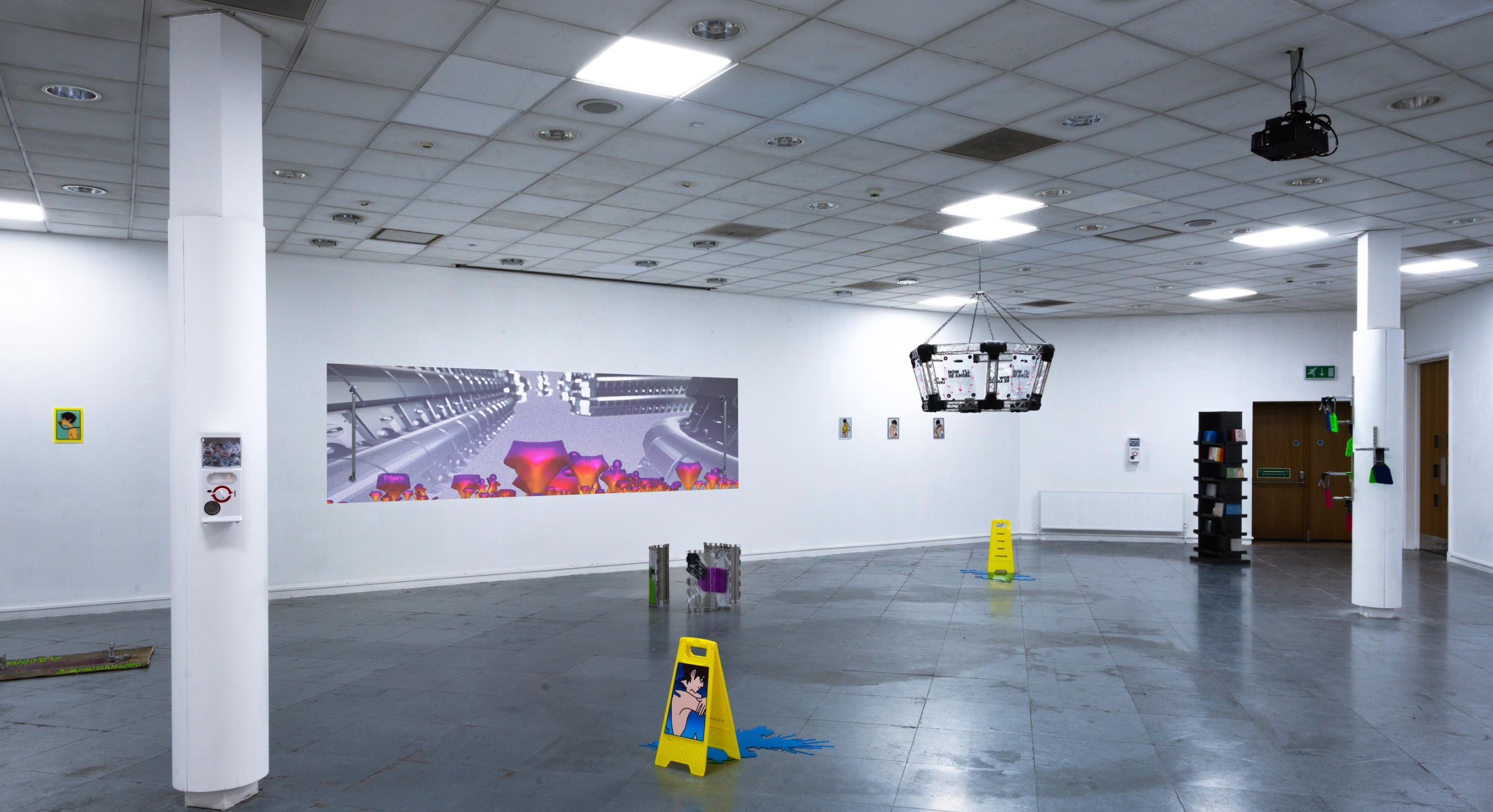
// NOTHING UNWANTED at ANNEX by The Koppel Project
“Pop culture has become a natural point of entry because it is almost a heightened, universalised version of everyday life. Whether it's a celebrity, a consumer product, a brand, or an online trend, they're shared points of reference that show how value, aspiration, identity, and communication are constructed at a much larger scale.”
– Interview with Mathijs Hunfeld
Afar, Hunfeld’s installation series 10X showed an enlarged version of the commonly seen in-store price tags. Made of industrial nylon, resin, and belt buckles, the brightly coloured price tags were the sole focus; the products to be complemented were nowhere to be seen. By transforming a disposable price tag into a neatly produced, almost collectable item, 10X called to the exhibition title, // NOTHING UNWANTED, by critically thinking about how modern marketing and design tactics have shaped impulsive purchasing. Thinking back on the 2024 Labubu craze, a plush toy with a fanged smile produced by POPMART, the IP became coveted through celebrity endorsement, strategically cute design, and an affordable price range. Currently, this softly formed and playful aesthetic is at its cultural peak, with the ability to take away all kinds of reasoning; picture-ready is favoured over functionality, and locality requires one to take a step further into thinking beyond the aesthetic.
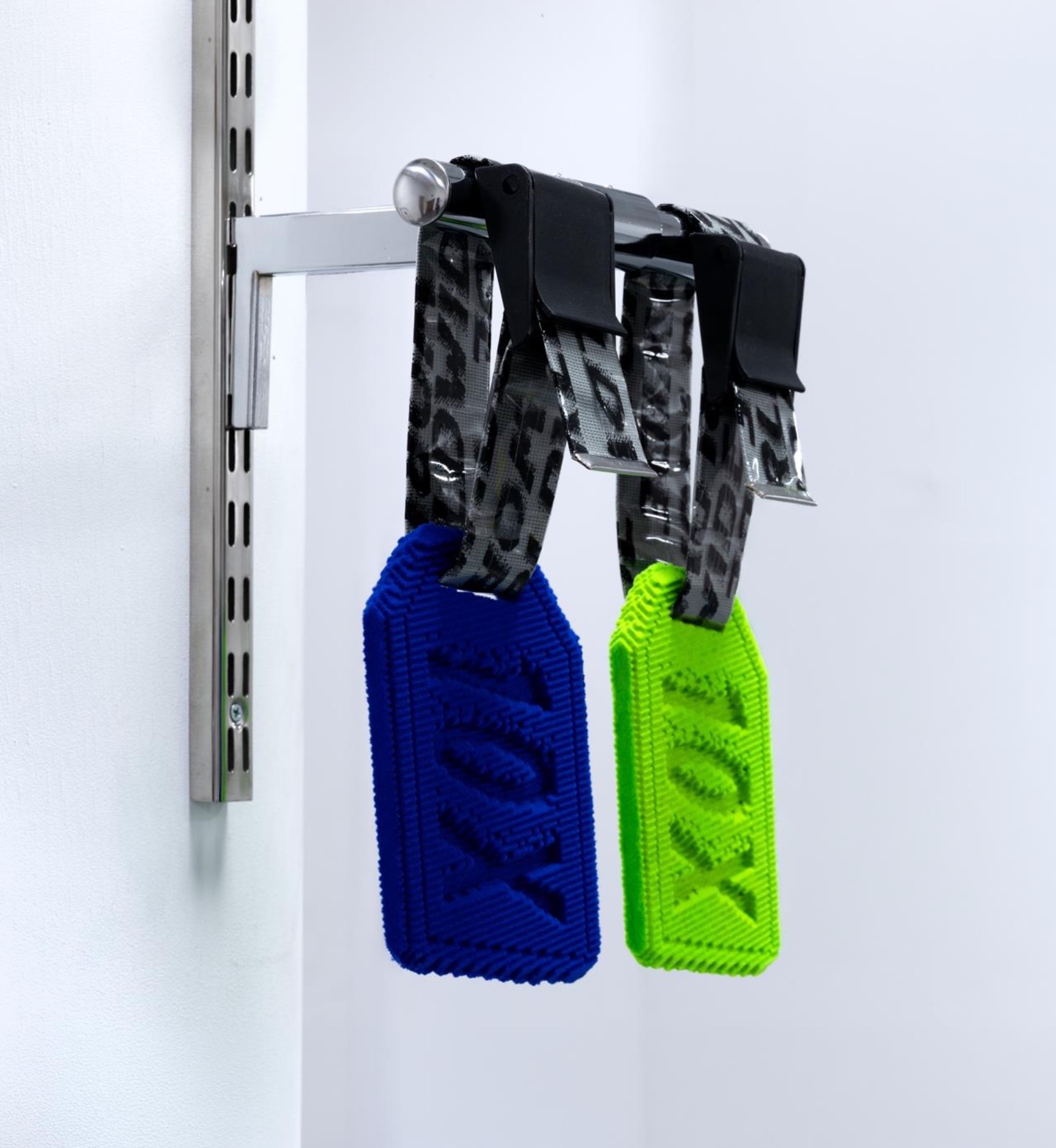
10X by Mathijs Hunfeld
Opposite of 10X, two large prints of innocent-looking boys were quietly situated in the space. Styled after early 2000s anime with similar features of characters from then-very popular series such as Black Butler, Ouran High School Host Club, and Fruits Basket, the subjects were memories excavated from Rahman’s formative years when encountering anime for the first time. By not giving them names, these slender boy figures were stripped away of individuality; instead of characters, it is more appropriate to interpret them as vessels of desires, encouraging direct gaze from the viewer. Consequently, this series of two boys was titled salaryman I and salaryman II.
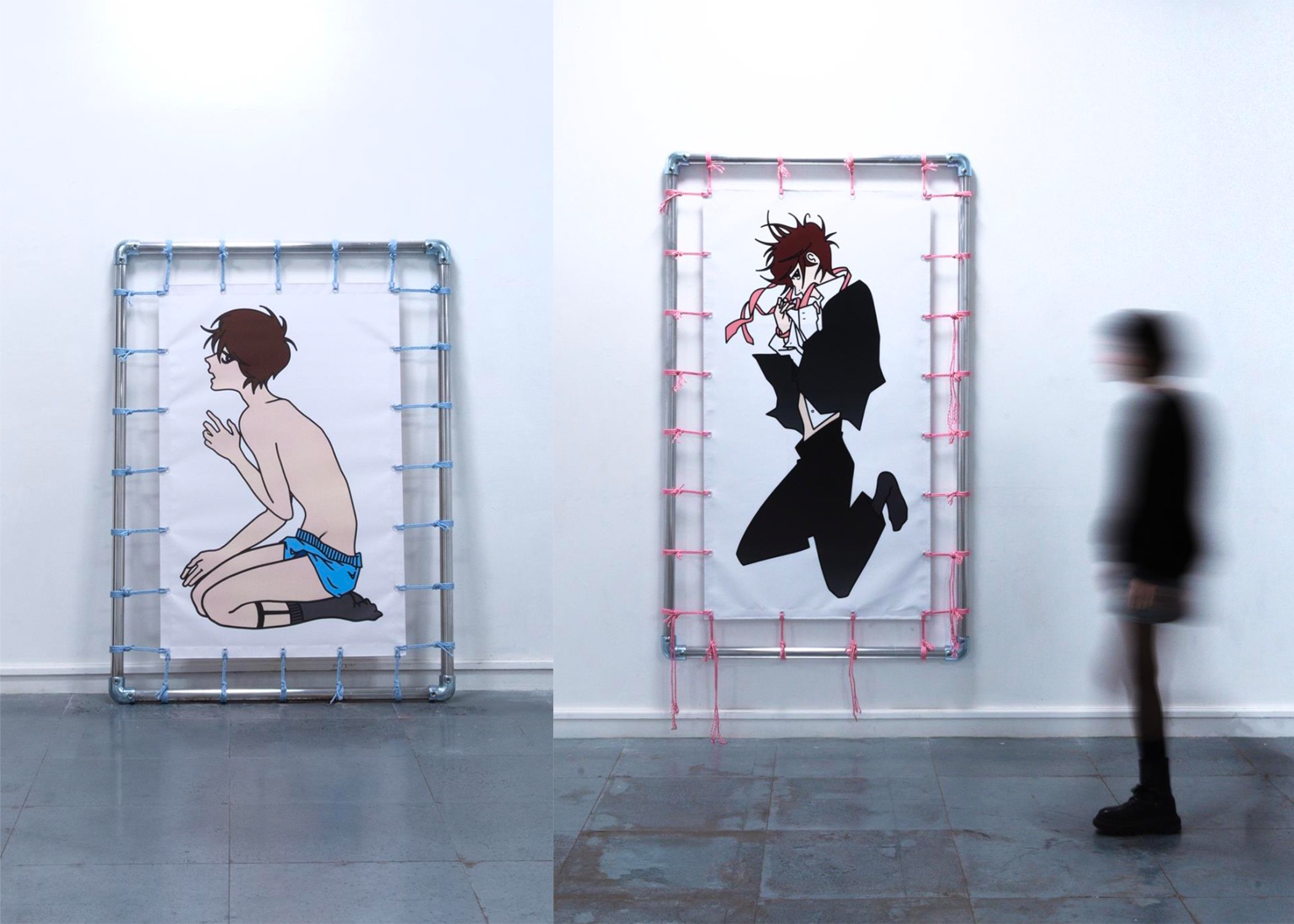
(left) salaryman I and (right) salaryman II by Attiyyah Rahman
Known for its rigid hierarchies, overtime work, and often obligatory nomikais (after-work drinking parties), Japanese salarymen are constantly subjected to stress and depression. Treading between the threshold of tension and release, Rahman outfitted the boy subjects with the salaryman attire, creating a visual narrative where the exterior reality meets the interior desire. The erotic motifs that could be seen through the subjects’ surrender position and puppy eyes were further emphasised by the framing of salaryman I and salaryman II: firmly bonded to aluminium poles with ropes. What were the loosely-dressed boys trying to tell us? The salaryman series seemingly mocked the masochistic nature of corporate loyalty, transforming the pressing subject of intense work culture into two desirable mascots. However, looking at the two beautiful boys, the urgency of social discourse suddenly does not matter anymore, as if aiding me as an impact bracer, I felt at ease escaping reality as long as they were present.
“The more I consciously work with cuteness and harmlessness, I think more about the urgency and the seriousness of the topics that sit beneath these surfaces. It’s important to not forget what this cuteness may truly embody, or where it came from.”
– Interview with Attiyyah Rahman
A while ago, I read some articles about the Tokoyo kids, a group of runaway youth in Tokyo who often gather in Shinjuku or Kabukicho district. In their frilly skirts and adorable ponytails, these kids – as young as 12 – often overdose on medications, abuse substances, and are subjected to predatory behaviours from being vulnerable on the streets. Terms such as menhera (mental healther) or jirai-kei (landmine type) came to describe the Toyoko kids’ nightlife culture and the contrast between their innocent appearance and unstable personality. As Maya B Kronic once mentioned in their book, Cute Accelerationism, that ‘one day everything will be cute’, I couldn’t help but think about the current romanticisation of mental health and the use of adorable mascots for political activities. Rahman’s salaryman series was obedient, adorable, and harmless, yet the roles that the boys took on were alarmingly real. TWO / EIGHT / ONE took ‘cuteness as a facade’ even further. A series of three instructional images was printed on aluminium sheets, recreating the formality of aeroplane instructions through intentional colour palette and texture. The three instructions, marked with the numbers 2, 8 and 1, depicted the tying of a life jacket, brace position, and the fastening of a seatbelt during plane take-off. Incorrectly numbered, the attractive boy figures once again took on the role as a filter for disorientation, and a vessel that cushions the impact from real-life pressure. Through these subtle remarks, Rahman sensibly expressed the duality of harmless and soft subjects.
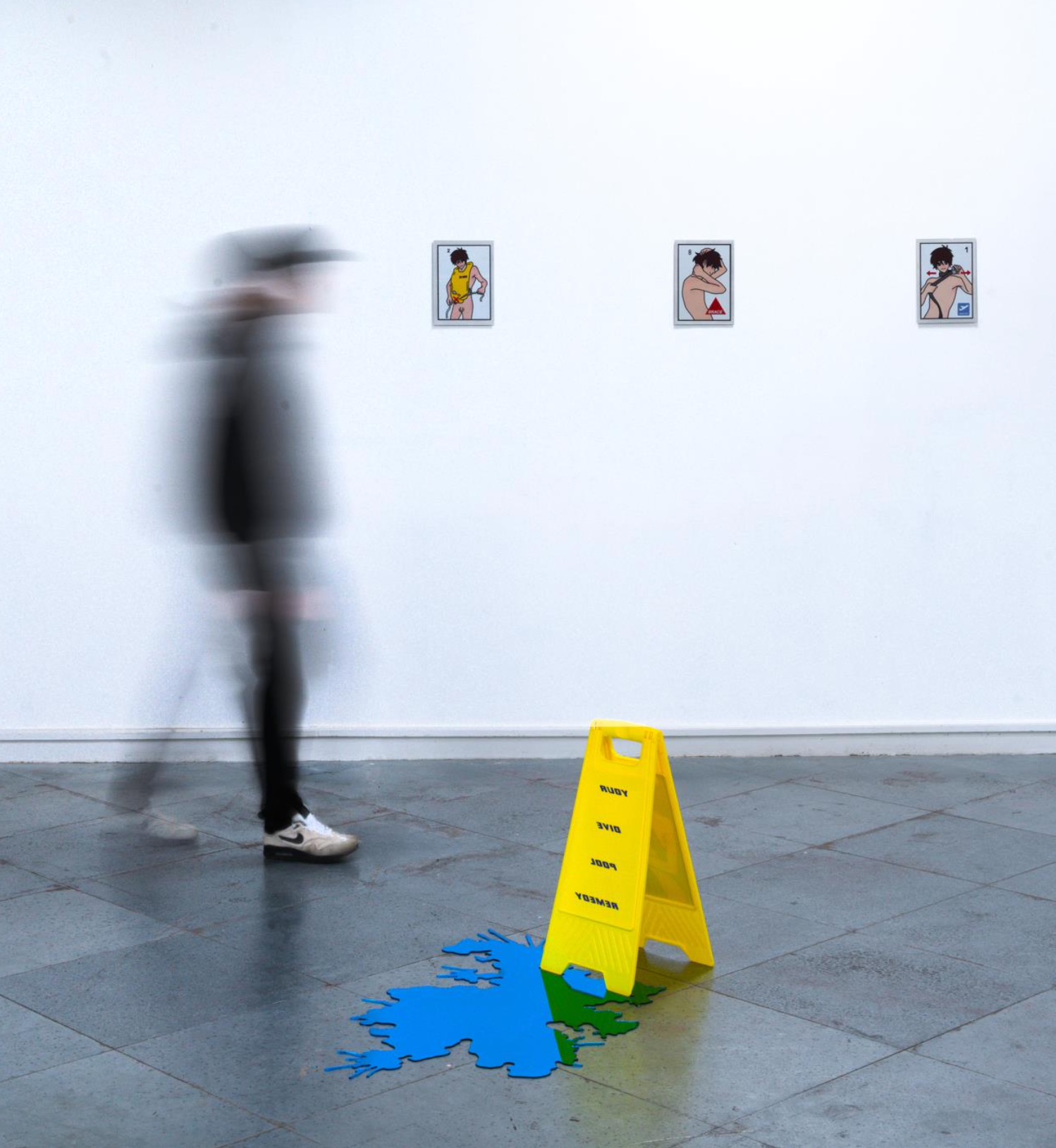
TWO / EIGHT / ONE by Attiyyah Rahman
So what does it mean to be a modern-day consumer when social media and the need for aesthetics are omnipresent? Hunfeld’s NOW, I’LL BEE AN ANGEL and Untitled (store sign) served as a representation of the current direction of Western design through his usage of material texture and colour composition. Responding to popular phrases and lifestyle images such as ‘girl core’, ‘tumblr girls’, or ‘ethereal’, these internet slangs not only became a label of a person’s ‘vibes’, but also a marketable tactic for businesses to increase engagement through similarly relatable content. Through his accelerationist approach to consumerism, Hunfeld seemed to satirically address that only by being amidst and surrendering to the chaos will you see through the smoke and mirrors of the current phenomena that encourages excessiveness and small purchases. At the same time, Rahman’s intimately crafted installations such as The Living Room and Mind Games provided a further push towards the act of embracing through narration of nostalgia and comfort.
About the Artists
Attiyyah Rahman (b. 2002, UK) graduated with an MA in Contemporary Art Practice from the Royal College of Art in 2024, and a BA (Hons) from Leeds Arts University in 2023. Her practice is guided by the autonomy of fantasy, psychological projection, and semi-autobiographical experience, where fiction and reality become increasingly indistinguishable; her anime-inspired character is used to explore questions surrounding representations of gender, youth, and taboo within online spaces. Her work has been exhibited across a variety of spaces, including Camden Art Centre, Leeds Art Gallery, Feelium Gallery, Tate Modern, and Hypha Studios.
Mathijs Hunfeld (b. 2000, Netherlands) graduated with an MA in Contemporary Art Practice from the Royal College of Art in 2024, and a BA in Product Design from ArtEZ. His practice examines fantasy, desire, and identity by recontextualising everyday objects, exposing tensions between glorification and collapse in late capitalism. Using satire and irony, he critiques emotional dependencies and self-sabotaging behaviour within pop culture. His work has been exhibited and published internationally, including at Tate Modern, the London Design Festival, and Gallery 46; more recently, he will undertake a residency with Art’otel London Hoxton. Alongside his practice he has curated exhibitions, made visual narratives, and project promotion within his area of industry.